Local Business · Construction
Full Measures LLC
Twenty-five years of work on the New Jersey shore, and a website about to be switched off. Building the site was the straightforward half — getting a domain out of one provider, hosting into another, and the business email through it all in one piece was the rest of the job.
- Client
- A commercial and residential construction company on the New Jersey shore.
- Service area
- Ocean & Monmouth County, NJ — 25+ years in business.
- Situation
- The existing website was being shut down; the domain sat with a different provider.
- Scope
- Five pages: home, three service pages, contact.
- Role
- Content, design, build, and the whole domain and hosting handover.
- Outcome
- Live on its own domain, with the business email carried through intact.
The challenge
A long-standing business, about to go invisible.
The old website was being shut down, and by the time we were brought in it was already returning nothing at all. For a contractor whose customers check you exist before they call, that is not a cosmetic problem.
The awkward part was underneath. The domain had been registered in one place, hosting bought in another, and a transfer already started toward a third. That is completely ordinary for a small business — these accounts pile up over years — but it turns going live into a sequence of registrar locks, authorisation codes and propagation windows, none of which are signposted, and one of which quietly kills your email if you get the order wrong.
- 25+
- years in business
- 3
- providers standing between them and a live site
- 5
- pages to write, design and build
The shape of it
Five pages, each with a job.
The first outline ran to nine pages, with decks and pool houses standing on their own and a separate about page. We consolidated. There was no team page to write — it is a construction company, and the story belongs on the homepage next to the work — and three thin outdoor pages would have competed with each other in search rather than adding up. Five pages, each with enough substance to rank and a clear reason to exist.
-
Home
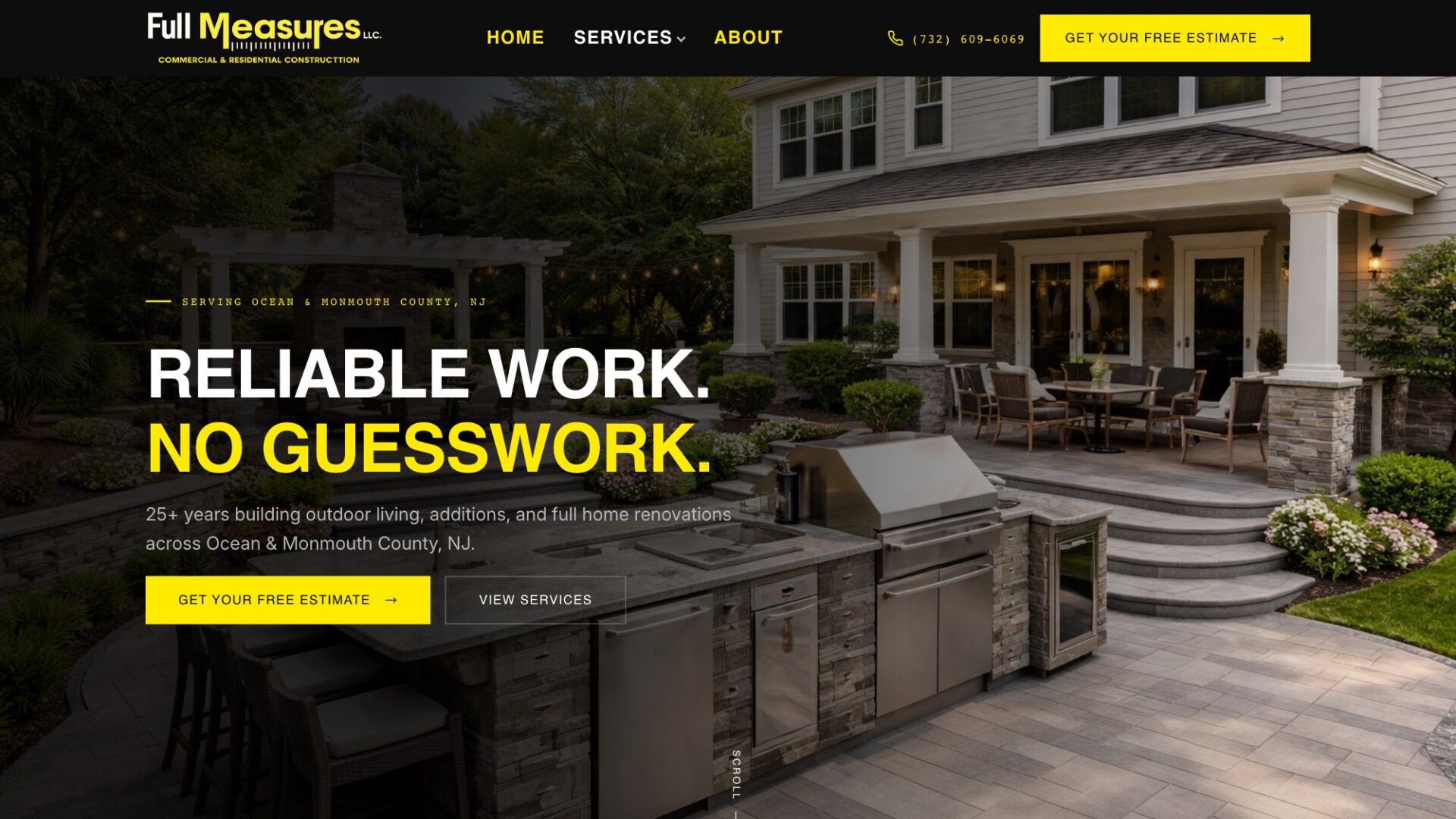
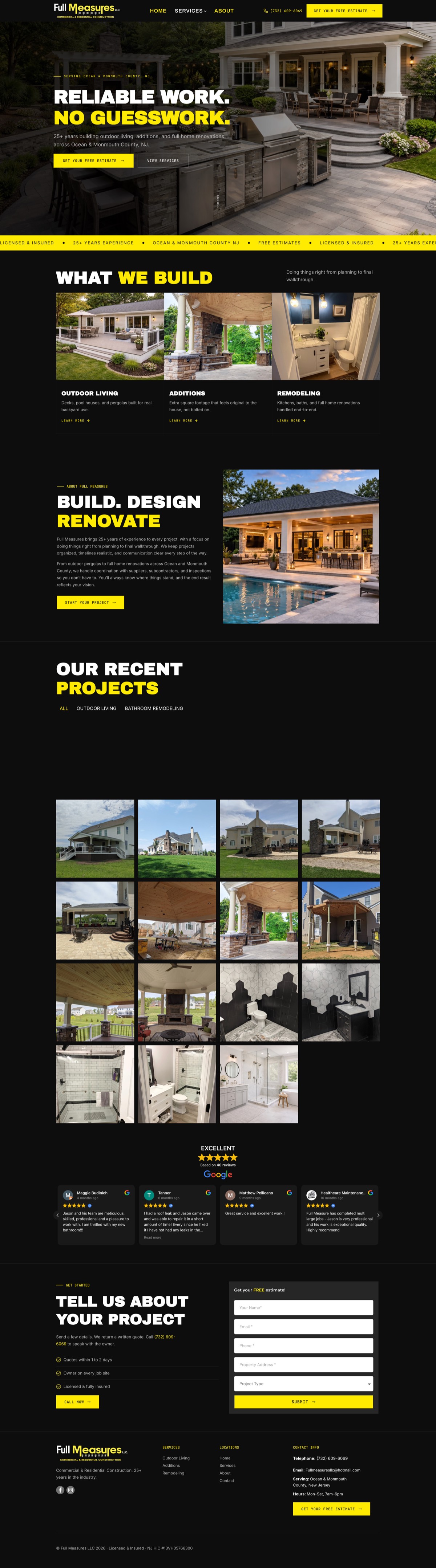
Hero, services, the about story, the project gallery, reviews and the enquiry form — the whole business on one page.
-
Outdoor Living
Decks and pool houses folded in here rather than split across three thin pages that would compete with each other.
-
Additions
Extra square footage that reads as original to the house.
-
Remodeling
Kitchens, baths and full home renovations, handled end-to-end.
-
Contact
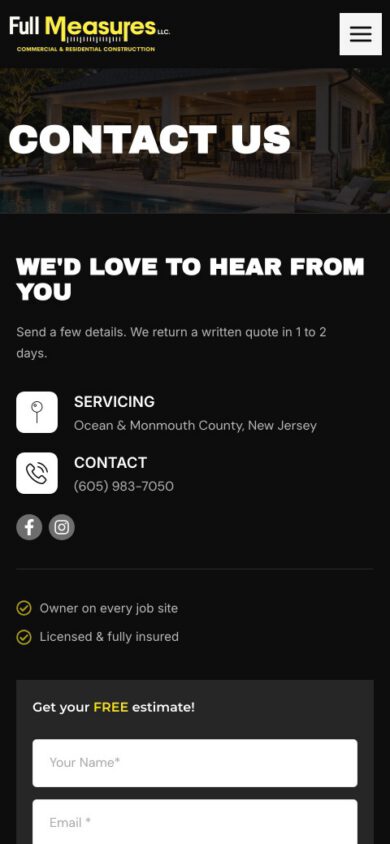
One form, a phone number, and the service area stated plainly.
A page per service
Somebody searching decks should land on decks.
Each service gets its own page, its own photographs and its own copy, rather than three paragraphs sharing the homepage. The brief was black, yellow and white, clean, and not wordy — so every page opens with what it is, proves it with real jobs, and asks for the call.
-
Outdoor Living
fullmeasuresllc.com/outdoor-living/
-
Additions
fullmeasuresllc.com/additions/
-
Remodeling
fullmeasuresllc.com/remodeling/
The homepage
Real jobs, not stock photos.
Every photograph on the site is their own work, pulled from what the client sent over and from their social accounts. A remodeller is selling craftsmanship, and a stock kitchen tells a visitor nothing about whether this crew can build theirs. The gallery filters by work type, so a homeowner can look only at the thing they came for.
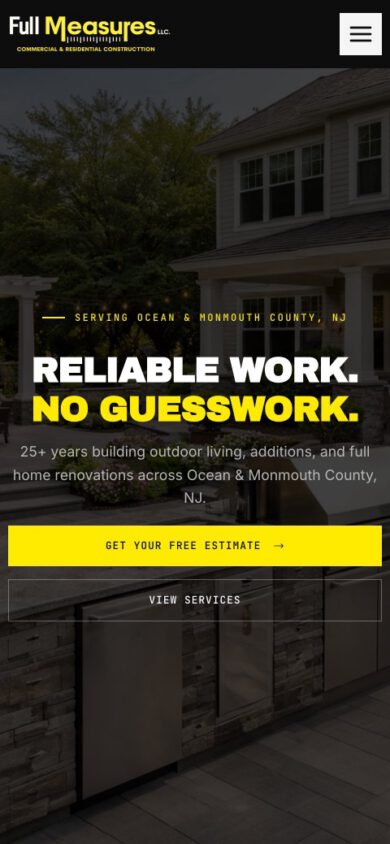
On the phone
Where a homeowner actually finds a contractor.
The call button sits in the header on every screen, the gallery stays swipeable, and the enquiry form asks for five fields rather than fifteen. Nothing needs a pinch-zoom to read.

Getting it live
Building the site was the easy half.
Most of what stands between a small business and a working website is not design. It is a registrar lock, an authorisation code, a nameserver record and a propagation window — spread across accounts nobody has signed into for years. Our job was to know the order, and to walk the client through their side of it one screen at a time instead of pointing them at a support page.
-
Build first, domain later
The site went up on a temporary hosting URL straight away, so design and content were never waiting on a registrar. By the time the domain was sorted, there was a finished website ready to point at it.
-
Unlock and get the auth code
A domain cannot move while it is locked. That means signing in to the old registrar, removing the transfer lock and requesting the authorisation code — three steps in three different screens, none of them labelled obviously.
-
Save the email records before anything moves
The step that costs people their business email. MX, TXT, SPF and DKIM records live with the domain, and once a transfer completes they are gone and very hard to reconstruct. We copied them down first.
-
Point the DNS instead of waiting
A registrar transfer takes five to seven days. Rather than sit on a finished site, we pointed the A and CNAME records at the new host — same result, live in hours instead of a week.
-
Sort the account permissions
The domain was shared to the right account but without the domain service ticked, so it simply did not appear. Diagnosed it, sent the exact three clicks needed, and it showed up immediately.
Step three is the one worth repeating. Email records travel with the domain, and the day a transfer completes is the day info@ stops working — usually to everyone’s surprise, and usually with no copy of what the records used to say.
What we delivered
The whole thing, start to finish.
- Five pages written, designed and built from scratch
- A dedicated page for each of the three services
- The client's own project photography throughout — no stock imagery
- Their real Google reviews pulled onto the homepage
- Filterable project gallery, by work type
- Enquiry form with the trust points beside it: quote in 1–2 days, owner on site, licensed and insured
- Black, yellow and white, matching the logo they already had
Where it landed
Live, on their own name.
- The finished build was ready inside two weeks, ahead of the agreed delivery window
- Live on its own domain rather than a temporary hosting URL
- Business email survived the registrar move
- Twenty-five years of work finally has somewhere to point people
The site launched recently, so there is no meaningful search data to show yet. We would rather say that than publish a number that has not earned its place.
Why this one matters
“It’s live” is the only milestone that counts.
A finished design sitting on a staging URL is worth nothing to a contractor in Ocean County. Plenty of small businesses end up with exactly that — a site they paid for and cannot launch, because the last mile is registrar admin and the designer’s job stopped at the handover. We treat that last mile as part of the work, and we do the parts that need doing rather than emailing instructions and hoping.
Not sure where your domain even lives?
Most people aren’t. We build the site and handle the registrar, the hosting and the email records, so the only thing you have to do is approve the design.